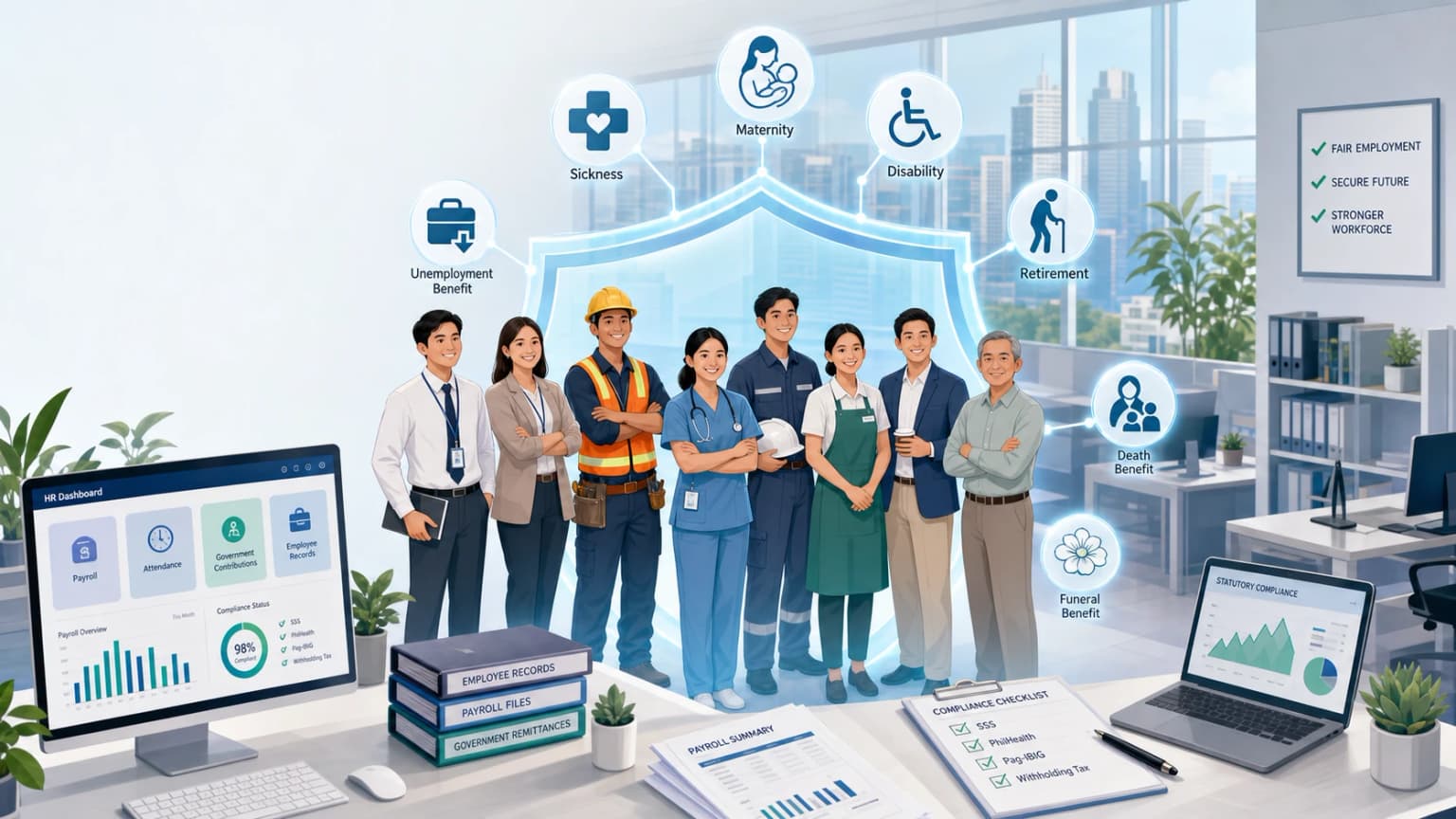
When most people think about Social Security System (SSS) contributions, they think of one thing: salary deductions.
But SSS is much more than a monthly deduction from payroll.
It is one of the most important financial safety nets available to Filipino workers and their families. Whether an employee gets sick, welcomes a new child, loses a job, becomes permanently disabled, retires, or even passes away, SSS provides financial assistance during life's most difficult moments. This is why the Department of Labor and Employment (DOLE) highlights Social Security Benefits as one of the key sections in its Compliance Guide for employers.
What Are Social Security Benefits?
Under the Social Security Act of 2018 (Republic Act No. 11199), SSS provides income replacement whenever a member experiences situations that temporarily or permanently affect their ability to earn. These include:
- Illness
- Childbirth
- Disability
- Retirement
- Death
- Unemployment
Instead of facing these events without financial support, qualified members receive cash benefits to help cover expenses and replace lost income.
Why This Matters More Than Most Employers Realize
For employers, SSS compliance is not simply about following government regulations.
It is about protecting employees during some of the most challenging periods of their lives.
Imagine an employee who:
- Is hospitalized for several weeks
- Gives birth to a child
- Suffers a permanent disability
- Is unexpectedly laid off
- Reaches retirement after decades of service
Without proper SSS contributions, these employees could lose access to benefits specifically designed to provide financial relief.
Employers who fail to register employees or remit contributions may also face legal liabilities, penalties, and even become responsible for benefits that employees should have received from SSS.
Who Is Covered?
According to the DOLE Compliance Guide, SSS covers:
- Employees in the private sector
- Kasambahays (domestic workers)
- Employers
- Employees below 60 years old under mandatory coverage
Coverage generally begins on the employee's first day of work, making timely registration and contribution remittance an important employer responsibility.
Understanding the Seven Major SSS Benefits
SSS provides seven major cash benefits to qualified members and their families. Each benefit has its own eligibility rules and documentation requirements, but together they form the core of the protection that SSS membership offers.
1. Sickness Benefit
Employees who cannot work because of illness or injury may receive a daily cash allowance while recovering.
This helps reduce the financial burden when medical conditions prevent someone from earning regular income.
2. Maternity Benefit
Female members who are unable to work due to childbirth, miscarriage, or emergency termination of pregnancy may receive daily cash benefits.
For growing families, this benefit provides valuable financial support during maternity leave.
3. Retirement Benefit
Years of regular contributions eventually become retirement protection.
Qualified members receive either:
- Monthly pension, or
- Lump-sum benefit
This creates a stable source of income after leaving the workforce.
4. Disability Benefit
Permanent partial or total disability can significantly affect a person's ability to earn.
SSS provides financial assistance through either monthly pensions or lump-sum benefits depending on eligibility.
5. Death Benefit
If an SSS member dies, qualified beneficiaries may receive financial support through:
- Monthly pension, or
- Lump-sum benefit
This helps surviving family members cope with the loss of household income.
6. Funeral Benefit
Funeral expenses can be financially overwhelming.
SSS provides a funeral benefit to the person who paid for the burial expenses of a deceased member or pensioner.
7. Unemployment Benefit
One of the newer protections introduced under RA 11199 is unemployment insurance.
Eligible employees — including qualified kasambahays and Overseas Filipino Workers (OFWs) — who lose their jobs involuntarily may receive temporary cash assistance while searching for new employment.
Regular Contributions Unlock These Benefits
One important message from the DOLE guide is simple:
SSS benefits depend on active membership and contribution compliance.
Both employers and employees have responsibilities.
Employers should:
- Register employees on time
- Deduct the correct contributions
- Remit contributions promptly
- Maintain accurate payroll records
Employees should:
- Verify that contributions are being posted
- Keep their SSS records updated
- Monitor their My.SSS account regularly
Consistent contributions today can make a significant difference when benefits are needed in the future.
Why HR Teams Should Pay Close Attention
For HR professionals, SSS compliance goes beyond payroll processing.
It affects:
- Employee trust
- Legal compliance
- Government inspections
- Employee satisfaction
- Business reputation
Late registrations or missed contribution remittances can expose companies to penalties and employee complaints while delaying access to important benefits.
How an HRIS Helps Maintain SSS Compliance
Managing statutory contributions manually becomes increasingly difficult as a company grows.
An HR Information System (HRIS) can help organizations:
- Maintain accurate employee records
- Automate payroll computations
- Track mandatory government contributions
- Generate compliance reports
- Reduce payroll errors
- Improve audit readiness
Automation does not replace compliance knowledge — but it makes compliance much easier to achieve consistently.
428HR is designed around the goal of bringing Philippine HR, payroll, attendance, leave, and statutory contribution workflows into one connected platform. Businesses evaluating an HRIS should still confirm that its configuration matches their organization and the latest SSS, PhilHealth, Pag-IBIG, and BIR requirements.
Final Thoughts
The DOLE Compliance Guide reminds us that Social Security is more than a legal requirement — it is a long-term investment in the well-being of every Filipino worker.
From sickness and maternity to retirement and unemployment, SSS provides financial protection when people need it most. For employers, ensuring timely registration and contribution remittance is not just about avoiding penalties; it is about fulfilling a responsibility that directly impacts employees and their families.
As your workforce grows, having reliable HR processes and the right HRIS can make SSS compliance simpler, more accurate, and less stressful.
References
| Resource | Purpose |
|---|---|
| DOLE Compliance Guide (PDF) | Primary source used for the article, including the Social Security Benefits section. |
| Social Security System (SSS) – Employees Guide | Official explanation of employee coverage, registration, contributions, and benefits. |
| Social Security System (SSS) – Employer Guide | Employer obligations, employee reporting, remittance requirements, penalties, and compliance. |
| Social Security System – Household Employer Guide | Coverage and responsibilities for kasambahay and domestic worker employers. |
| SSS Citizens' Charter (2025 Edition) | Official overview of SSS services, mandate, and benefit programs. |
| SSS Circular 2025-009 (Disability Benefit Program) | Current official circular on disability benefits under RA 11199. |
| DOLE Bureau of Working Conditions – Webinar on SSS Benefits and Services | Explains employer responsibilities and how SSS compliance is checked during labor inspections. |
| DOLE Bureau of Working Conditions – Online Compliance Portal | Official information about DOLE's compliance reporting portal. |
| DOLE Quezon – Downloadable Forms | Related compliance forms and workplace programs for employers. |
Official Reference and Disclaimer
This article was prepared with reference to the DOLE Quezon compliance reference PDF and the official SSS and DOLE resource pages linked above.
SSS laws, contribution schedules, eligibility rules, and government guidance can change. Verify the latest requirements with the Social Security System, the Department of Labor and Employment, the relevant government agency, or a qualified professional before making decisions for your organization.
This article provides general information and not legal advice. The article and its illustration are 428HR editorial materials and do not imply endorsement by the SSS, DOLE, or any other government agency.